
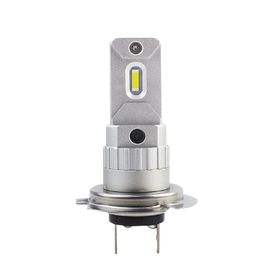
14 watts 1680 lumens
100% Plug&Play LED. Size 1.1 similar to your halogen bulb. Installation possible without making...
€12
46
In stock

Products related to this item
14 watts 1680 lumens
100% Plug&Play LED. Size 1.1 similar to your halogen bulb. Installation possible without making...
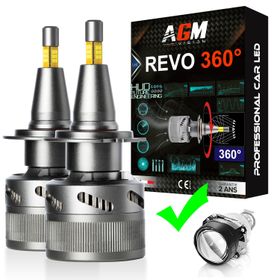
120 watts 22000 lumens
Designed for lens headlights. Powerful and precise lighting, without shadow zones.
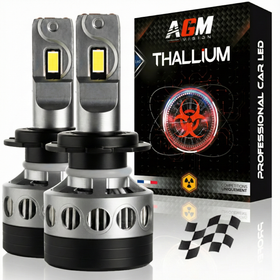
170 watts 32000 lumens
Extreme power, wide and long-range lighting, rather recommended for competition.
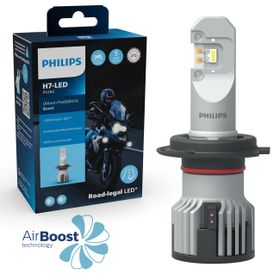
15 watts 1550 lumens
Philips Ultinon Pro6000 BOOST HL H7 LED Motorcycle for front headlight. ± 5800 K. 3-year warran...
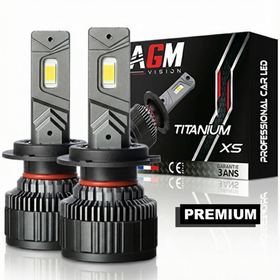
110 watts 20500 lumens
High-end ventilated H7 LED, mini size, featuring extreme power. 3-year warranty.

70 watts 10800 lumens
Ventilated and powerful, with a size comparable to an H7 halogen bulb.
Unlike a halogen bulb, which shines in all directions, an H7 LED bulb emits its light from chips placed on the flat sides of its body. The reflector or lens of your headlight was designed for a light source positioned exactly like the original filament. An LED installed the wrong way produces a distorted beam: blurry cutoff line, shadow areas, reduced range and above all glare for oncoming drivers — a reason for a re-inspection at the technical inspection and a real safety risk.
The filament of an H7 halogen bulb is a small horizontal cylinder placed at the center of the optic. To reproduce it, the LED chips must be horizontal, i.e. positioned at 3 o’clock and 9 o’clock (one chip face on the left, one chip face on the right) once the bulb is locked into its holder. The chips must never end up at the top and bottom: the beam would go into the reflector in an erratic way.
For a classic reflector headlight (chrome background), the answer is simple: the LED chip faces are placed laterally, horizontally. Most AGM Vision kits, like the H7 LED kit GTR PRO 1:1 (70 W, identical size to the halogen) or the Titanium XS V2 (110 W), lock in the right direction thanks to their retaining ring. After installation, simply check, by eye, that the chips are correctly oriented at 3 o’clock/9 o’clock; some models allow fine rotation of the base to adjust the angle to the nearest degree.
In an optic with a projection lens, the light is taken up by the lens and not by a reflector: the position of the chips is less critical, but a 360° emission gives the best result. That is exactly the design of the H7 LED kit Revo 360°, whose chips, arranged all around the axis, eliminate shadow areas in projector headlights.
Park the vehicle about 5 meters from a wall, low beams on. You should see a sharp and horizontal cutoff line, with the characteristic rise on the right side. If the cutoff is blurry, double, or if the light goes upward, the bulb is incorrectly oriented: rotate the bulb body until you get a crisp cutoff. Compare both headlights: they must be symmetrical.
First, forcing a bulb that is not properly clipped in: on H7, the bulb is secured by a ring or tabs, and some vehicles (VW, Mercedes, BMW…) require a specific mounting adapter — without it, the bulb rotates freely and the beam gets out of adjustment while driving. Second, confusing the rotation of the connector with that of the LED body: it is indeed the orientation of the chips that matters. Third, forgetting to re-adjust the headlight height after the change: a 5-minute adjustment that prevents glare.
If you want to avoid any orientation questions, choose a kit in a 1:1 format identical to the halogen, with a pre-indexed ring, like the GTR PRO 1:1: it installs in the same direction as the original bulb, without modification. Find all our models, from compact format to high-power kit, in our H7 LED bulbs category — each product sheet specifies the recommended headlight type (reflector or projector) and the level of CANbus anti-error.