
Dipped headlights: use, regulations and choice of lighting
Dipped headlights: what are they for, when to switch them on, halogen, xenon or LED, how to recognize the right base and what the law says about LED retrofitting
In brief
- Dipped headlights illuminate at short and medium distances without dazzling other drivers: they are the default nighttime lighting and are also mandatory in tunnels and in poor visibility.
- Driving at night without suitable lighting is a 4th-class traffic offense and may result in the vehicle being immobilized.
- The bulb base (H7, H4, H1…) determines compatibility more than the brand or technology.
- A “universal” LED bulb in a halogen headlight is still prohibited on public roads; only certain LEDs approved since 2022 are permitted, subject to conditions.
Contents
- What is a dipped headlight?
- When should you switch on your dipped headlights?
- Which technology should you choose for your dipped headlights?
- How can you identify the bulb type in your dipped headlights?
- Can you switch your dipped headlights to LED? What the law actually says
- Choosing and maintaining your dipped headlights
- Frequently asked questions
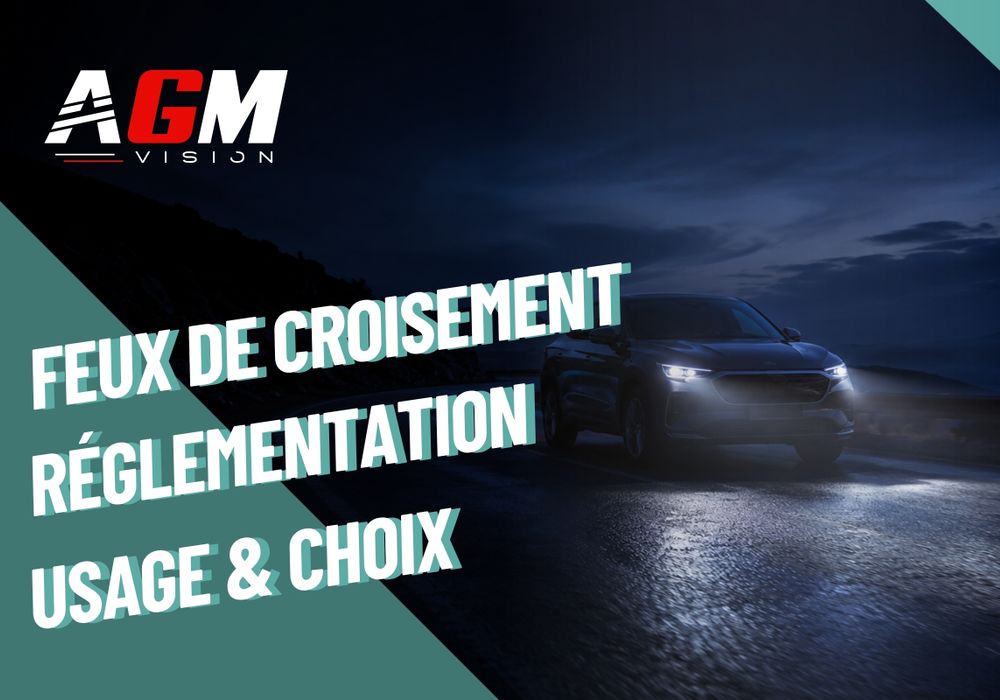
Dipped headlights are the lights you use most often when driving, without always thinking about it. They allow you to see the road at night without dazzling oncoming drivers. Yet many motorists confuse them with high beams or daytime running lights, do not know exactly when to switch them on, and are unaware of what the law allows when they want to switch to LED.
In this guide, we take a comprehensive look at the subject: what dipped headlights are really for, when to switch them on, what technologies are available (halogen, xenon, LED), how to identify your vehicle’s bulb type and, above all, what French regulations say about replacing bulbs with LEDs. Everything you need to see clearly before touching your lighting.
What is a dipped headlight?
A dipped headlight (also called a “low beam” or sometimes a “dipped-beam headlight”) is the vehicle’s main front light for driving at night in traffic. Its distinctive feature is the shape of its beam: it is directed downward and cut off asymmetrically, higher on the right-hand side (in France) to illuminate the roadside, and lower on the left-hand side so as not to dazzle oncoming vehicles.
This precise cutoff is what makes all the difference compared with a high beam. It is also why a vehicle’s lighting is a calibrated optical system: the bulb’s position, reflector and lens are designed together to produce this regulated beam.
Dipped headlights or high beams?
The distinction is simple once you know it:
- Dipped headlights illuminate at short and medium distances, with a beam directed toward the ground so as not to inconvenience other road users. They are the default lighting for nighttime driving.
- High beams illuminate far ahead and high up, without a cutoff. They offer a much greater range, but dazzle other drivers; they are therefore reserved for roads without public lighting and with no nearby vehicles. As soon as a vehicle approaches (ahead or in the opposite direction), switch back to dipped headlights.
On some vehicles, dipped and high beams use two separate bulbs; on others, they use a single dual-filament bulb (typically an H4).
What about parking lights and daytime running lights?
Another common source of confusion. Parking lights (or sidelights) are low-intensity lights: they help others see you, not help you see, and are never enough to illuminate the road. Daytime running lights (DRLs) switch on automatically during the day to make the vehicle visible, but they do not illuminate anything at night either. Neither of these lights replaces dipped headlights after dark.
When should you switch on your dipped headlights?
Dipped headlights are mandatory whenever visibility requires them. In practice:
- At night, when driving, both on roads and in towns.
- In tunnels, at any time of day.
- In poor visibility: heavy rain, fog, snowfall, at dawn and at dusk.
Please note: when street lighting is sufficient in built-up areas, parking lights may be enough in certain situations, but dipped headlights remain the rule whenever visibility decreases. Driving at night without suitable lighting, or with non-compliant lighting, exposes you to a 4th-class traffic offense (a fixed fine of €135, reduced to €90) and may even result in the vehicle being immobilized. Beyond the legal aspect, this is above all a matter of safety, for you and for others.
Which technology should you choose for your dipped headlights?
Three main technologies are used in dipped headlights today. Each has its own rationale.
Halogen remains the original lighting technology in most vehicles on the road. It is a proven, economical technology that is easy to replace, but its light is rather yellow and its lifespan is limited compared with more recent solutions. It is the starting point for most setups.
Xenon (discharge lamps, D series) provides much brighter, whiter light with a long range. It is fitted as original equipment in many recent or high-end vehicles. It requires a ballast and suitable optics.
LED is the most modern technology: white light close to daylight, very low power consumption, a very long lifespan and instant illumination. It has become the go-to choice for anyone wanting to modernize their lighting, provided they comply with the regulations, which we discuss below.
For a detailed explanation of the differences in how these three types work and their lifespans, see our article how halogen, xenon and LED bulbs work and how long they last. You can also find all our xenon and halogen bulbs, as well as our range of LED kits and bulbs.
How can you identify the bulb type in your dipped headlights?
Before choosing anything, you need to identify your bulb’s base, that is, its connection format. This determines compatibility far more than the brand or technology. The most common bases for dipped headlights are:
- H7 — single-filament base, one of the most common types for dipped headlights.
- H4 — dual-filament base: it provides both dipped and high beams on vehicles with only one bulb per headlight.
- H1 — single-filament base, commonly used for dipped or high beams, depending on the model.
- H11 — very common, for both dipped headlights and fog lights.
- HB3 (9005) and HB4 (9006) — often used for high beams or other functions, depending on the vehicle.
To find out which one you have, try these three things: consult your vehicle’s manual, check the marking on the original bulb after removing it, or use a model-specific compatibility guide. If you are unsure which format you need, our article what are the differences between H1, H4 and H7 bulbs? will help you see clearly.
Once you have identified the base, you can explore the right solution among our H-series LED bulbs and kits. We also have guides dedicated to each format: how to choose the right H7 LED bulb, the right H4 LED bulb and kit, and the right H1 LED kit.
Can you switch your dipped headlights to LED? What the law actually says
This is the most sensitive question, and the one surrounded by the most misconceptions. Here are the facts.
A headlight is approved as a complete unit, with a specified light source (a halogen filament, for example). Changing this source alters the beam distribution. That is why, for a long time, fitting an LED bulb in a headlight designed for halogen bulbs was prohibited on public roads—and this is still the case for so-called “universal” LEDs.
The situation changed with the decree of October 28, 2021, which established a “national approval” procedure in France for replacement LEDs (retrofits). Since early 2022, certain LED bulbs have therefore been approved to replace halogen bulbs on public roads. The Philips Ultinon Pro6001 led the way, followed by other models (OSRAM Night Breaker LED, etc.).
However, this authorization comes with strict conditions:
- Approval is valid only for a specific list of vehicles (model by model). An LED approved for one car is not automatically approved for another.
- Installation may require a specific accessory or adapter supplied by the manufacturer.
- Once the LED is installed, you must stick the supplied label under the hood and keep the national approval certificate in the vehicle, ready to present during an inspection.
Conversely, fitting an LED that is not approved for your vehicle remains prohibited on public roads, even if it provides better illumination. The risks include a fine (a 4th-class traffic offense, €135), failing or being required to undergo a follow-up inspection at the roadworthiness test—which now checks lighting compliance—or even having the vehicle immobilized.
Our advice: before making any purchase intended for road use, check that the LED has national approval for your specific model, using the official list published by the manufacturer. For more information, read our dedicated article: Approved H7 LED: we explain everything.
(Information current as of 2026; regulations and lists of approved vehicles are updated regularly. Remember to check the applicable references at the time of purchase.)
Choosing and maintaining your dipped headlights
Beyond technology and legality, a few criteria make a difference to the actual quality of your lighting.
Bulb base compatibility comes first: this is non-negotiable. A bulb in the wrong format will not fit properly or will produce a poorly directed beam.
Beam quality is more important than the stated power alone. A good dipped headlight illuminates the road evenly, without dark spots or glare. This is precisely what well-designed optics and products guarantee.
Color temperature is the final consideration. White light between 4,000 and 6,000 K offers the best balance of comfort and visibility while remaining realistic. Beyond that (very bluish shades at 8,000 K and above), the light looks “tuned,” but actually illuminates less effectively and falls outside approval standards.
Finally, two maintenance steps will help your dipped headlights remain effective: headlight adjustment (even the best bulb performs poorly if the headlight is misaligned—see our 4 things to know to adjust your headlights properly) and restoring yellowed or cloudy headlight lenses, which filter light and reduce visibility: see our headlight restoration solutions.
LEDs for your vehicle
Enter your vehicle to see compatible bulbs for each light.
Frequently asked questions
Products in this article

70 watts 10100 lumens
All-in-One ventilated, powerful and compact, with dimensions similar to a halogen H4 bulb, it e...

70 watts 10100 lumens
Revolution! The H1 GTS Slim Ventilated bulb stands out for its Compact Size and Amazing Perform...

70 watts 10800 lumens
Ventilated and powerful, with a size comparable to an H7 halogen bulb.

AGM Vision
Specialists in LED lighting for cars, motorcycles, trucks and tractors, based in Excideuil since 2005.
About usRelated articles
LED H7 bulb installation orientation: horizontal or vertical?
If it’s misaligned, an H7 LED dazzles and lights poorly. Here’s how to correctly position your H7 LED bulbs depending on your headlight type, and check the beam after installation.
11 Jun 2026
What are the differences between the H1, H4, and H7 bulbs?
All the recommendations to improve your road safety thanks to H1, H4 and H7 bulbs.
16 Sep 2024
Practical guide: how to choose and optimize your car headlights?
Both in terms of safety and aesthetics, vehicle lighting is a crucial aspect. Discover the different types of car headlights in this article!
22 Jan 2024