
License plate lighting: 2026 regulations
License plate lighting in 2026: requirement, readability at 20 m, fines from €68 to €135, vehicle inspection and compatible LED bulbs
In brief
- Rear license plate lighting is mandatory for any registered vehicle: the plate must remain legible from 20 meters at night (Article R313-12 of the Highway Code).
- A burned-out or missing bulb costs €68 in fines; a prohibited color, €135.
- The light must be white and must not change the color of the plate: blue, green, or red are prohibited.
- During the roadworthiness test, completely defective plate lighting is a major defect that requires a retest.
Contents
- Key points to remember in 2026
- What do the 2026 regulations say about license plate lighting?
- What is the fine for defective license plate lighting in 2026?
- 2026 roadworthiness test and license plate light
- What color should rear license plate lighting be?
- Types of license plate bulbs
- Why switch to LED in 2026?
- How to choose a license plate bulb
- How to change a license plate bulb
- Maintaining license plate bulbs
- Frequently asked questions
The license plate bulb is undoubtedly the most discreet light on your vehicle, and yet one of the most frequently checked. It ensures that your plate is legible at night, affects the validity of your roadworthiness test, and exposes you to a fine in the event of a failure. This comprehensive guide, updated for 2026, reviews the regulations in force, the penalties you may face, the roadworthiness test criteria, as well as the selection, installation, and maintenance of your plate lighting, whether it uses conventional bulbs, LEDs, or Plug & Play modules.
Key points to remember in 2026
- Rear license plate lighting is mandatory for any registered vehicle: car, motorcycle, scooter, truck, trailer, motorhome, quad, tractor (Article R313-12 of the Highway Code).
- The plate must be legible from at least 20 meters at night, in clear weather.
- The light must be white and must not alter the color of the plate (except for vehicles approved before October 1, 1998).
- €68 fine for a defective or missing plate light, €135 for non-compliant lighting (prohibited color).
- During the roadworthiness test, a defective light source is a major defect: a retest is mandatory.
- Front license plate lighting is not required by law.
What do the 2026 regulations say about license plate lighting?
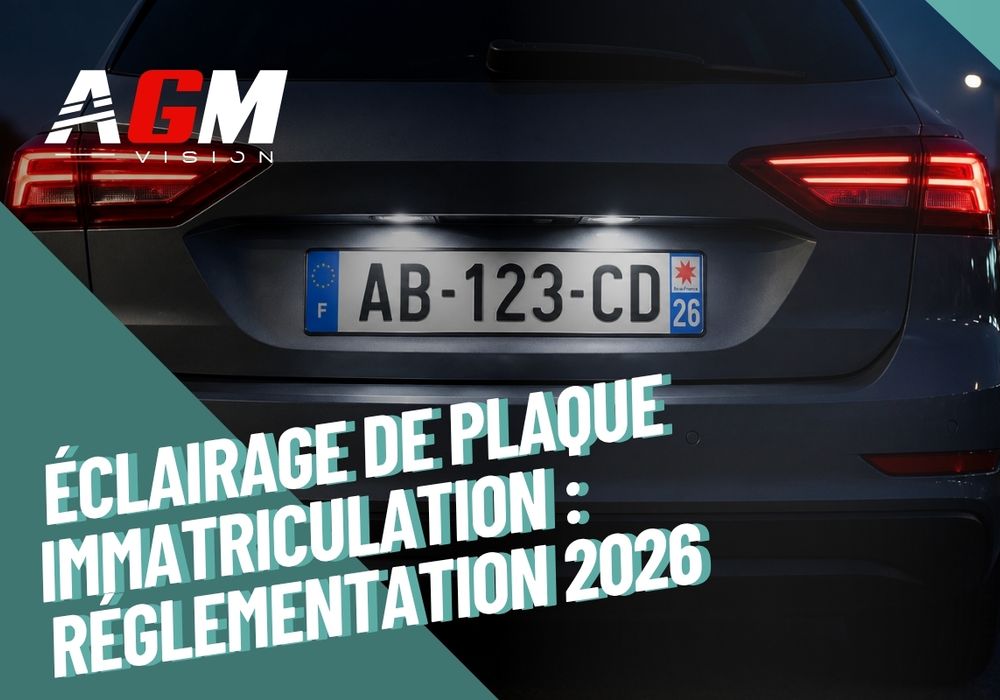
✅ In 2026, in France, rear license plate lighting remains mandatory for all registered vehicles. The reference text has not changed: it is Article R313-12 of the Highway Code, which requires the rear plate to be legible from a minimum distance of 20 meters:
Every motor vehicle or trailer must be equipped with a lighting device capable of making the number displayed on its rear license plate or operating plate legible from a minimum distance of 20 meters at night, in clear weather. For towed agricultural vehicles, this device may be attached to a removable support.
This requirement applies to a very wide range of vehicles: cars, motorcycles, scooters, trailers, caravans, motorhomes, quads, trucks, agricultural machinery, etc. Only emergency and firefighting vehicles may be exempt when this requirement is incompatible with their technical characteristics:
The provisions of this article apply to special vehicles and equipment used by emergency and firefighting services only if they are compatible with their technical characteristics of manufacture or use.
However, front license plate lighting is not required by law. No lighting device is required at the front of the vehicle for the plate.
What is the fine for defective license plate lighting in 2026?
In the event of non-compliance with the regulations, two levels of penalties apply in 2026:
- A fixed fine of €68 (class 3 offense) for a defective or burned-out bulb, or if there is no rear license plate lighting device.
- A fixed fine of €135 (class 4 offense) for non-compliance, for example, if lighting of an unauthorized color is used instead of the required white.
The good news: these offenses do not result in any points being deducted from your driver's license. However, law enforcement may require the vehicle to be brought into compliance, or even immobilize it in the most serious cases. A plate bulb costs just a few euros: it's not worth taking the risk.
2026 roadworthiness test and license plate light
As part of the roadworthiness test, the rear plate lighting is thoroughly checked under the category “Condition and operation (rear license plate lighting device)”. Six criteria are assessed, with two levels of severity:
- The light emits direct light toward the rear: minor defect
- Light source partially defective: minor defect
- Light source defective: major defect (retest)
- Light not properly secured: minor defect
- Light not properly secured, with a very high risk of detachment: major defect (retest)
- Non-compliance with requirements: minor defect
In practical terms, if your vehicle has two plate lights and only one works, you receive a minor defect, with no retest. If none of the bulbs light up, a retest is guaranteed. Checking your bulbs before the test takes thirty seconds and avoids having to present the vehicle a second time.
Please note: since April 2024, the roadworthiness test also applies to motorcycles, scooters, and other motorized two-wheelers. In 2026, your motorcycle's plate lighting is therefore checked too: a point often overlooked on customized motorcycles whose plate holder has been modified.
What color should rear license plate lighting be?
The Highway Code does not explicitly specify the color of license plate lighting, but this does not mean that complete freedom is allowed. An order dated March 26, 1998, transposing European Directive 76/760/EEC, stipulates that the light emitted must be white and must not alter the original color of the plate. Using blue, green, or purple bulbs is therefore illegal and carries a €135 fine for non-compliance.
As for vehicles with yellow or orange plate lighting, they are not necessarily in violation: the white-light requirement has applied only since October 1, 1998. Vehicles approved before that date may retain their original lighting, in accordance with the legislation in force at the time — like other features of classic cars, such as classic models without seat belts.
Types of license plate bulbs
License plate bulbs mainly come in three types: traditional incandescent bulbs, modern LED bulbs, and Plug & Play LED lighting modules. Each solution has its advantages: warm light and low cost for incandescent bulbs, energy efficiency and pure white light for LEDs, and perfect compatibility for Plug & Play modules, which are particularly suited to German vehicles equipped with a defective-bulb detection system (CANbus).
➡️ The most common bases for plate lighting are the T10 W5W, the C5W festoon bulb and, less commonly, the R5W. If you want to switch to LED easily, without dashboard errors and with 100% guaranteed compatibility, choose from our LED plate lighting modules, specially designed for each car make and model.

✅ In stock
Why switch to LED in 2026?
For plate lighting, LED is now the most practical choice. It uses up to 80% less electricity than an incandescent bulb and offers a much longer lifespan — tens of thousands of hours, compared with a few hundred for a conventional bulb. The result: fewer replacements, less risk of driving with a burned-out light, and a more favorable environmental impact over the entire life cycle.
The pure white light of LEDs (generally 6000K) fully meets the regulatory requirement for white light, while giving the rear of the vehicle a more modern look, in harmony with the LED daytime running lights on newer vehicles. Just make sure to choose a quality LED with a compliant white hue and no excessive bluish tint.
How to choose a license plate bulb
Your choice is not limited to a preference between LED and incandescent. Four criteria should guide your purchase: brightness (sufficient for legibility from 20 meters, without dazzling), light color (white is mandatory), compatibility with your vehicle (base and CANbus system), and durability. An informed choice ensures better performance and avoids frequent replacements.
➡️ If in doubt, use our vehicle or license plate LED search on your make's page, or contact us by phone: we'll tell you the exact part number compatible with your model.
How to change a license plate bulb
Installing a new bulb may seem intimidating, but it is one of the easiest jobs to do yourself, in just a few minutes and with a simple screwdriver:
- Open the bulb cover: insert a flathead screwdriver into the notch provided and pry to unclip the cover, or unscrew the screws, depending on the model.
- Remove the bulb: locate the bulb, then remove it using the screwdriver or simply with your fingers.
- Insert the new bulb: place the bulb in the connectors. With an LED, make sure to point the emitting face toward the license plate. Then replace the cover.
This method may vary depending on your vehicle model. On some newer models, the plate light is a complete unit that must be unclipped: this is precisely what our Plug & Play LED modules are designed for; they can be replaced in one minute, without any special tools.
Maintaining license plate bulbs
Regular maintenance ensures the longevity and reliability of your plate lighting. A few simple steps are all it takes: clean the transparent cover (dirt can significantly reduce the plate's legibility), check the condition of the connections and seals, and check that the lights work once a month — a useful habit before every roadworthiness test or long night drive.
LEDs for your vehicle
Enter your vehicle to see compatible bulbs for each light.
Frequently asked questions
Products in this article

0.25 watts 10 lumens
Universal LED module for motorcycle, car, trailer license plate lighting....

2.5 watts 410.6 lumens
Choose powerful and long-lasting LED lighting with this pack of high-performance R5W bulbs, des...

Light up your Renault in style with the kit of 2 LED lighting modules for license plate Renault...

Light up your Peugeot in style thanks to the kit of 2 LED lighting modules for the license plat...

Light up your Mercedes in style thanks to the kit of 2 LED lighting modules for Mercedes Type 4...

Innovative mounting bracket for European license plates, designed to facilitate the installatio...

6 watts 730 lumens
Choose powerful and long-lasting LED lighting with this high-performance W5W bulb pack, designe...

AGM Vision
Specialists in LED lighting for cars, motorcycles, trucks and tractors, based in Excideuil since 2005.
About usRelated articles
Front and rear fog lights: when should you turn them on?
Front or rear, rain, snow or fog: what the Highway Code says, the warning lights to recognize and the fine for forgetting.
20 Nov 2026

Gift for a car and tuning fan: 15 ideas for 2026
LED neon lights, interior lighting, yellow headlights, LED bars and detailing: our gift ideas for car enthusiasts, tuning fans and car meetups
4 Nov 2026

Gift for a farmer: 16 useful ideas for the tractor (2026)
LED work lights, spray lights, beacons and road-approved lighting: our useful gift ideas for farmers
4 Nov 2026