
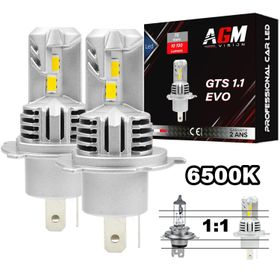
70 watts 10100 lumens
All-in-One ventilated, powerful and compact, with dimensions similar to a halogen H4 bulb, it e...
€54
08
In stock
Products related to this item
70 watts 10100 lumens
All-in-One ventilated, powerful and compact, with dimensions similar to a halogen H4 bulb, it e...
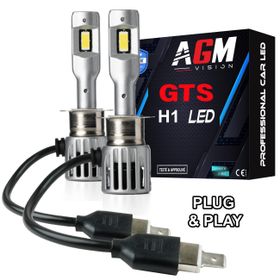
70 watts 10100 lumens
Revolution! The H1 GTS Slim Ventilated bulb stands out for its Compact Size and Amazing Perform...

70 watts 10800 lumens
Ventilated and powerful, with a size comparable to an H7 halogen bulb.
Low beam headlights are the lighting you use most often when driving, without always thinking about it. They are what allow you to see the road at night without dazzling oncoming drivers. Yet many motorists confuse them with high beams or daytime running lights, don’t know exactly when to switch them on, and are unaware of what the law allows when you want to switch to LED.
In this guide, we take a complete look at the topic: what low beams are really for, when to turn them on, what technologies exist (halogen, xenon, LED), how to identify your vehicle’s bulb type, and above all what French regulations say about replacing them with LEDs. Enough to see clearly before touching your lighting.
The low beam (also called “dipped beam” or sometimes “low beam headlight”) is the vehicle’s main front lighting for night driving in traffic. Its distinctive feature lies in the shape of its beam: it is aimed downward and cut off asymmetrically, raised more on the right-hand side (in France) to properly light the roadside, lower on the left-hand side so as not to dazzle vehicles coming the other way.
It is this precise cutoff of the beam that makes all the difference compared with a high beam. And it is also for this reason that a vehicle’s lighting is a calibrated optical system: the bulb position, the reflector, and the lens are designed together to produce this regulated beam.
The distinction is simple once you keep it in mind:
On some vehicles, low beam and high beam are provided by two separate bulbs; on others, by a single dual-filament bulb (typically an H4).
Another common confusion. Sidelights (or parking lights) are low intensity: they are meant to be seen, not to see, and are never enough to light the road. Daytime running lights (DRL) switch on automatically during the day to make the vehicle visible, but they don’t light anything at night either. Neither of these two lights replaces low beams after nightfall.
Low beams are mandatory as soon as visibility requires it. In practice:
Note: when public lighting allows it in built-up areas, sidelights may be sufficient in certain situations, but low beams remain the rule as soon as visibility decreases. Driving at night without suitable lighting, or with non-compliant lighting, exposes you to a 4th-class fine (fixed fine of 135 €, reduced to 90 €) and can even lead to the vehicle being immobilized. Beyond the legal aspect, it is above all a matter of safety, for you as well as for others.
Three main technologies equip low beams today. Each has its own logic.
Halogen remains the original equipment lighting for the majority of vehicles on the road. It is a proven, economical technology that is easy to replace, but its light is rather yellow and its lifespan is limited compared with more recent solutions. It is the starting point for most setups.
Xenon (discharge lamps, D series) offers much more powerful and whiter lighting, with a long range. It is found as factory fitment on many recent or high-end vehicles. It requires a ballast and suitable optics.
LED is the most modern technology: white light close to daylight, very low consumption, very long lifespan, and instant switch-on. It has become the reference for anyone who wants to modernize their lighting, provided you comply with the regulations, which we come back to below.
To understand in detail the differences in operation and longevity between these three families, our article operation and lifespan of halogen, xenon and LED bulbs takes stock. You will also find all of our xenon and halogen bulbs as well as our range of LED kits and bulbs.
Before choosing anything, you need to identify the base of your bulb, i.e., its connection format. This is what determines compatibility, far more than the brand or the technology. The most common bases for low beams are:
To find yours, three reflexes: consult the vehicle manual, look at the marking on the original bulb by removing it, or use a model-based compatibility guide. If you hesitate between several formats, our article what are the differences between H1, H4 and H7 bulbs will help you see clearly.
Once the base is identified, you can explore the suitable solution among our H-series LED bulbs and kits. We also have guides dedicated to each format: choosing your H7 LED bulb, your H4 LED bulb and kit, or your H1 LED kit.
This is the most sensitive question, and the one around which the most false ideas circulate. Here are things clearly.
A headlamp is approved as a whole, with a defined light source (a halogen filament, for example). Changing this source changes the beam distribution. That is why, for a long time, fitting an LED bulb in optics designed for halogen was prohibited on public roads — and this is still the case for so-called “universal” LEDs.
The situation evolved with the decree of 28 October 2021, which created in France a “national approval” procedure for replacement LEDs (retrofit). Since early 2022, certain LED bulbs have thus been approved to replace halogens on public roads. The Philips Ultinon Pro6001 paved the way, followed by other references (OSRAM Night Breaker LED, etc.).
But the authorization comes with strict conditions:
Conversely, fitting an LED that is not approved for your vehicle remains prohibited on the road, even if it lights better. The risk: a fine (4th-class offence, 135 €), a failure or a re-test at the roadworthiness inspection — which now checks lighting compliance — or even immobilization of the vehicle.
Our advice: before any purchase intended for road use, check that the LED does indeed have national approval for your exact model, relying on the official list published by the manufacturer. To go further, read our dedicated article: Approved H7 LED, we explain everything.
(Information up to date in 2026; regulations and lists of approved vehicles evolve regularly, remember to check the references in force at the time of your purchase.)
Beyond the technology and legality, a few criteria make the difference in the real quality of your lighting.
Base compatibility, first: it is the non-negotiable condition. A bulb in the wrong format will not fit correctly or will produce a poorly aimed beam.
Beam quality, next, is more important than the simple stated power. A good low beam lights the road evenly, without dark zones or glare. This is precisely what optics and seriously designed products guarantee.
Color temperature, finally. A white light between 4 000 and 6 000 K offers the best comfort/visibility compromise and remains realistic. Beyond that (very bluish shades at 8 000 K and above), the light looks “tuning”, but in reality lights less well and moves away from approval standards.
Two maintenance actions finally extend the effectiveness of your low beams: headlight adjustment (even the best bulb lights poorly if the optics are misadjusted — see our 4 things to know to properly adjust your headlights) and restoration of headlamp lenses that have yellowed or dulled, which filter light and reduce visibility: find our headlight restoration solutions.
What is the difference between low beams and high beams? Low beams light at short and medium distance with a beam dipped toward the ground, so you can see without dazzling: it is the default night lighting. High beams light far and high, without a cutoff, and are reserved for stretches of road without lighting and without another vehicle nearby.
When should you turn on low beams? As soon as visibility requires it: at night in traffic, in tunnels, and in bad weather (heavy rain, fog, snow, dawn and dusk). Driving with unsuitable or non-compliant lighting exposes you to a 4th-class offence.
Which bulb should you choose for a low beam? It all depends on your vehicle’s base (H7, H4, H1, H11, HB3, HB4…). Identify it via the manual or the marking on the original bulb, then choose a quality bulb in that format, with a realistic color temperature. If in doubt, rely on a model-based compatibility guide.
Can you replace your low beams with LEDs? Yes, but only with a replacement LED approved (national approval) for your exact vehicle, installed with any accessories that may be required, with the sticker under the hood and the certificate kept on board. Non-approved “universal” LEDs remain prohibited on the road, under penalty of a fine, a re-test at the roadworthiness inspection, or immobilization.
How do I know if a low beam bulb is compatible with my vehicle? First check the base (connection format), then, for road use in LED, make sure the reference does indeed appear on the list of approved vehicles published by the manufacturer. The vehicle manual, the marking on the original bulb, and a model-based compatibility guide are your best reference points.